

Franklin Moreno
June 15, 2026
A Guide to the Most Popular Productivity Methods


Disclaimer: This blog post is provided for general informational purposes only. The content is based on opinions, research, and personal perspectives at the time of writing and should not be considered professional advice. Readers should use their own judgment before relying on any information provided. Individual results and experiences may vary.
Whether you are a student trying to figure out how to focus and study without burning out, or a professional looking for ways to increase productivity at work, the challenge is almost always the same – too many things to do and too little structure to do them in. That is where productivity frameworks come in.
A productivity framework is not a life hack or a motivational poster. It is a repeatable system for deciding what to work on, when, and how. [1] And the good news is that several proven frameworks have been around long enough to be genuinely battle-tested – whether you need help with how to stop procrastinating, how to concentrate better, or simply how to stay consistent day after day.
Before diving into the frameworks themselves, it is worth understanding the scale of the problem they solve. According to Gitnux’s 2026 expert analysis of procrastination data, workers are 15% less productive daily due to procrastination, and the average employee spends significant chunks of their workday on non-work activities. [2] The same data shows that the Pomodoro Technique alone boosts task completion by 25%, while time blocking increases productivity by 22%. [2] These are not trivial gains – they are the difference between a productive day and a frustrating one.
The data from Gitnux’s 2026 report provides insights into the effectiveness of popular productivity frameworks and time management methods:
| Technique or intervention | Reported effect on procrastination / productivity |
| Pomodoro Technique | Boosts task completion by 25% |
| Time blocking | Increases productivity by 22% |
| Implementation intentions (if-then planning) | Cuts delay by 40% |
| Accountability partners | Improves follow-through by 65% |
| Breaking tasks into 2-minute chunks | 45% effective at reducing avoidance |
| Commitment devices | Boost task completion by 55% |
| Self-imposed deadlines | 40% better than open-ended tasks |
| Habit stacking | Builds habits 50% faster |
| Goal-setting workshops | 38% success rate improvement |
| Weekly reviews | Reduce procrastination by 24% |
Source: Gitnux Procrastination Statistics 2026 [2]
Notice how many of the most effective approaches map directly onto the frameworks covered below. These methods remain widely used because they help people work more effectively. Let us walk through each one.
1. Getting Things Done (GTD)

GTD is a comprehensive personal productivity framework developed by David Allen, first published in 2001. Its core principle is simple: your brain is for having ideas, not for holding them. [3] Instead of keeping a mental list of everything you need to do, GTD asks you to externalise all of it into a trusted system. Once everything is out of your head, you can actually concentrate better and engage with your work rather than constantly trying to remember what you have forgotten.
The method works in five steps: capture (gather everything demanding your attention), clarify (decide what each thing means and whether it is actionable), organise (put tasks into the right lists or calendar slots), reflect (review your system regularly), and engage (actually do the work). [4] GTD is especially useful for people juggling multiple projects or responsibilities who feel overwhelmed by the volume of things they need to manage. [5] The trade-off is that the initial setup can be time-consuming, and the system requires consistent effort to maintain. [4]
2. The Pomodoro Technique
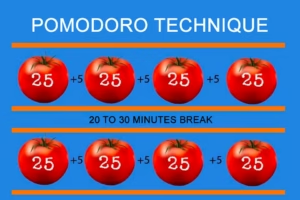
If you are looking for the simplest possible answer to how to concentrate better, the Pomodoro Technique is it. Developed in the late 1980s by Francesco Cirillo, the method divides work into 25-minute focused sprints – called “Pomodoros” – separated by 5-minute breaks. After completing four Pomodoros, you take a longer break of 15 to 30 minutes. [4]
The genius of Pomodoro is that it creates artificial urgency. A 25-minute block feels manageable even when a full project feels overwhelming, which is why it is particularly effective for how to stop procrastinating – and why the data backs it up with a 25% improvement in task completion. [2] It is the easiest productivity system to start with, and requires no complex setup or productivity tools. [5] The main limitation is that the 25-minute window can interrupt deep concentration, so it is less suitable for collaborative environments or tasks that naturally require longer, uninterrupted stretches. [5]
3. Time blocking

Time blocking is the practice of dividing your day into dedicated blocks of time, each assigned to a specific task or category of work. Instead of working from a reactive to-do list, you schedule everything on a calendar – including breaks, admin, and personal time – so your day has structure before it starts. [4]
Popularised by author Cal Newport as a cornerstone of deep work, time blocking is particularly powerful for anyone who loses hours to context-switching or finds themselves “busy but unproductive.” [5] The data shows it increases productivity by 22%, making it one of the most effective structural tools available. [2] The downside is inflexibility – roles with frequent interruptions or unpredictable demands can struggle to stick to a blocked schedule. [4] For those who need to know how to focus and study without distraction, though, it is one of the best frameworks available. The most effective approach is to combine GTD for capturing and organising tasks, then use time blocking to schedule when to actually complete them. [3]
4. The Eisenhower Matrix

Named after US President Dwight D. Eisenhower, this framework helps you prioritise tasks by sorting them into four categories based on two axes: urgency and importance. Tasks that are both urgent and important get done immediately; important but not urgent tasks get scheduled; urgent but unimportant tasks get delegated; and tasks that are neither get deleted entirely.
The Eisenhower Matrix is one of the most widely used productivity frameworks, and for good reason – it forces you to make deliberate choices rather than defaulting to whatever feels most pressing in the moment. [1] It works especially well when paired with a longer-term planning approach, since it keeps you from drowning in urgent trivia while still maintaining strategic direction. [3]
5. Eat the Frog

Inspired by a saying attributed to Mark Twain and popularised by productivity author Brian Tracy, Eat the Frog is built on one idea: identify your most important (and often most dreaded) task each day, and do it first thing in the morning. Everything else is easier after that. [5]
The “frog” is the task with the highest impact – the one you are most likely to put off precisely because it matters. By tackling it while your energy and willpower are at their peak, you avoid spending your best hours on low-value work. This makes it one of the most effective answers to how to stop procrastinating on the things that actually count. [4] It requires zero setup and can be layered onto any other framework – many practitioners combine Eat the Frog with Pomodoro sprints for the rest of the day, ensuring both the hardest task and focused execution are covered. [3]
6. The Kanban method

Originally developed by Toyota as a manufacturing workflow tool, Kanban has become one of the most popular frameworks for both teams and individual task management. It uses a visual board – typically divided into “To Do,” “In Progress,” and “Done” columns – where tasks move across as they are completed. [4]
The power of Kanban is visibility. You can see at a glance where your work stands, where bottlenecks are forming, and how much is genuinely in progress at any given time. This makes it one of the best productivity tools for teams working on multiple parallel workstreams. For individuals, personal Kanban boards offer a simple way to stay consistent without complex planning. The limitation is that heavily complex projects may need additional tools for detailed scheduling. [4]
How to choose the right framework (and how to stay consistent with it)
The most common mistake people make is treating productivity frameworks as personality tests – trying each one, deciding it “doesn’t fit,” and moving on. The research suggests the opposite approach works better: start with one system, and add a second only when the first has become a habit. [3]
A simple decision guide: if you feel overwhelmed by volume, start with GTD. If you lose time to distraction, try time blocking. If you struggle to start tasks, Pomodoro is your entry point. If you avoid your hardest tasks, Eat the Frog each morning. [5] Most professional teams benefit from combining two or three frameworks rather than relying on a single method – for example, using the Eisenhower Matrix to prioritise, then time blocking to schedule, then Pomodoro to execute. [1]
Consistency, not complexity, is what determines whether a framework sticks. Accountability partners have been shown to improve follow-through by 65%, and weekly reviews reduce procrastination by 24% – both of which suggest that the system you return to every day, however simple, outperforms the perfect system you abandon after a week. [2] The best productivity tools in the world are only as good as the habits built around them.
The system that works for you depends on what needs improvement in your current workflow – not on which method has the most enthusiastic advocates. [3]
Choose one framework from this list. Run it for two to four weeks before evaluating. Track your output honestly – not how busy you feel, but how much of what matters actually got done. That is the only metric that counts.
A Simpler Way to Stay On Track
If you’re serious about staying consistent, the tools you use matter. Instead of juggling scattered notes and overwhelming task lists, try a system designed to help you stay organized and keep moving forward. That’s where Ezytask comes in. It’s a to-do list built with a focus on completion, not just organization – helping you manage procrastination and maintain momentum.
If you want a simpler approach to productivity, check out Ezytask and see how a more streamlined system can support your workflow.
References
- Teamwork.com – 8 Best Productivity Frameworks for Project Managers (May 2026)
- Gitnux – Procrastination Statistics (2026): Expert Analysis
- iDel – Productivity System Guide 2026: GTD, Pomodoro, Time Blocking (March 2026)
- Campaign Refinery – 7 Productivity Systems to Help You Succeed in 2025 (January 2025)
- PeakLevs – Productivity Systems Compared: GTD vs Time Blocking vs Pomodoro vs Eat the Frog (March 2026)